


Breaking the Silos: Bridging the Gap Between IT and Business Operations
Operational silos slow transformation. Learn how LCAP provides a shared language for IT and Business, enabling faster collaboration and unified digital execution.
Jan 16 ,2026 - min readIn every large enterprise, there is a quiet tension that shapes daily operations. It is not dramatic, but its impact is profound. It shows up in support tickets, delayed workflows, and long email threads that circle around the same problems.
On one side are Business Operations teams. Sales needs faster approvals. HR needs smoother onboarding. Logistics wants real time visibility. To them, technology is a vehicle. If that vehicle slows them down, their performance suffers.
On the other side is IT. The guardians of security, stability, governance, and long term architecture. Their role is to prevent risk, not accelerate it blindly. Every request they receive competes with maintenance work, integration tasks, and compliance responsibilities.
Both sides work hard. Both sides want the business to excel. Yet the gap between them continues to grow.
The Rise of Operational Silos
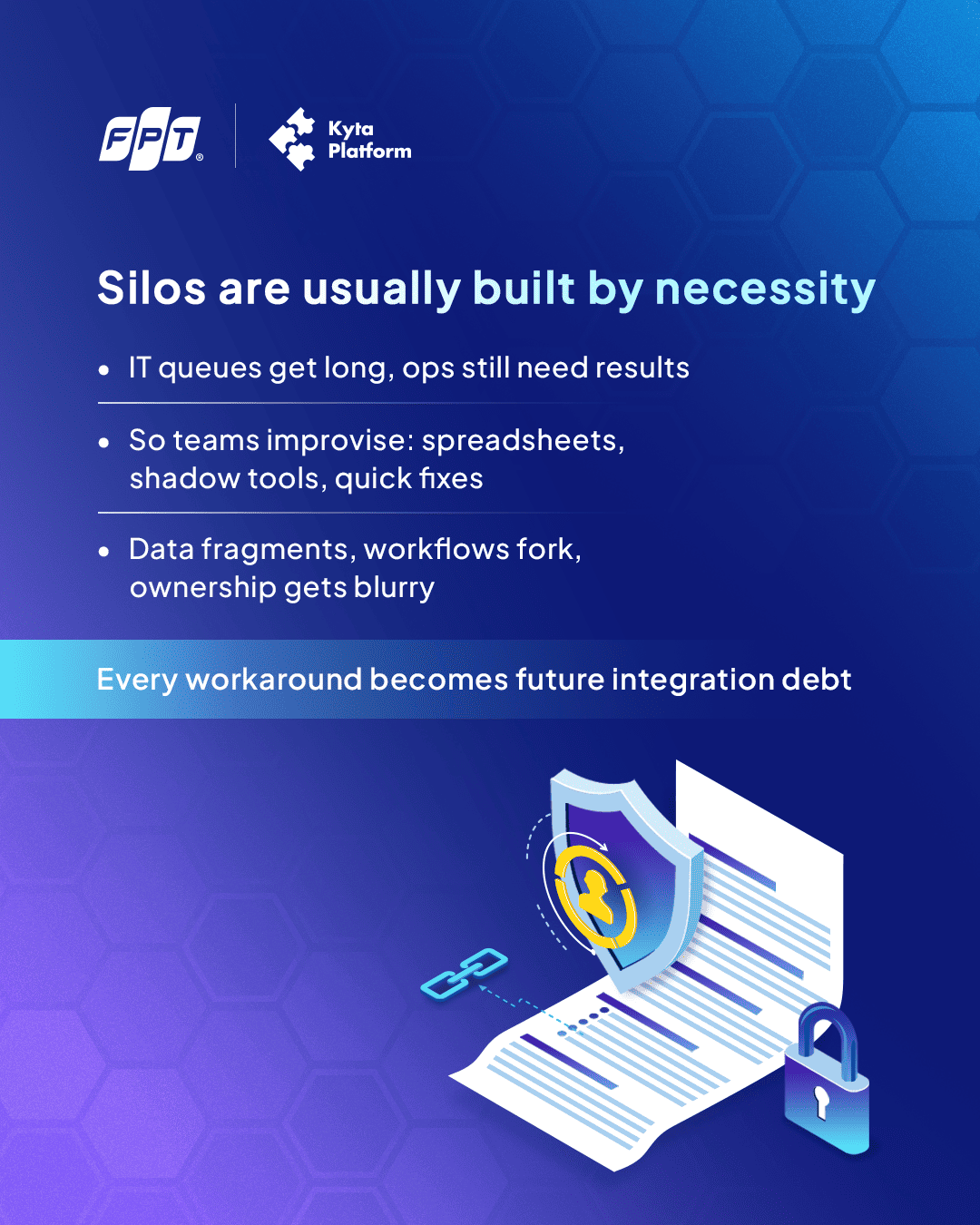
When IT cannot deliver fast enough, business teams improvise.
They open spreadsheets.
They create personal databases.
They sign up for isolated SaaS tools with no integration plan.
They hire freelance developers to build quick fixes.
These scattered solutions help temporarily, but over time they create an invisible maze. Data lives in separate pockets. Processes rely on individual habits rather than shared systems. No one has a complete picture of how work truly flows.
This is how operational silos form. Not by intention, but by necessity.
The Translation Problem
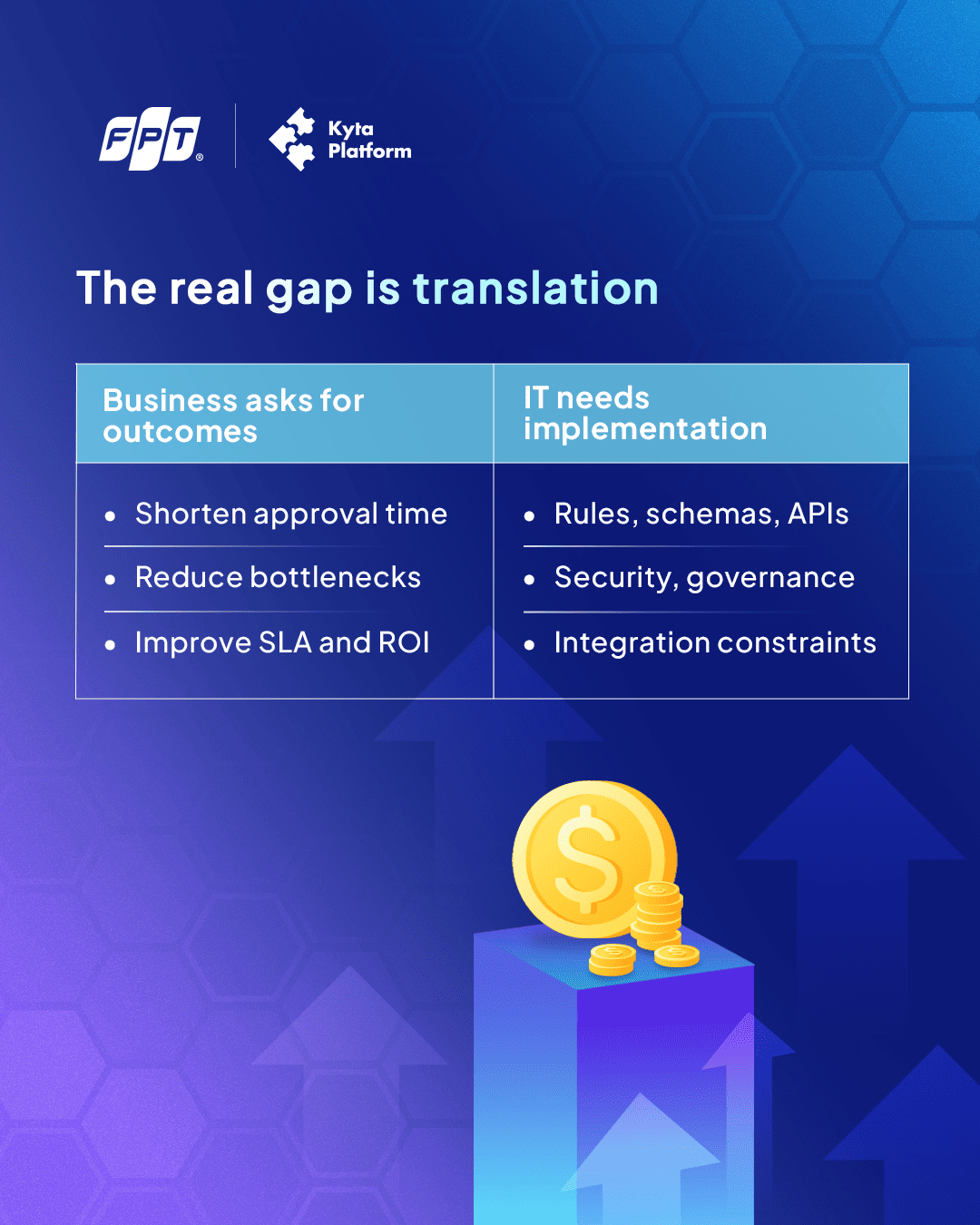
The real divide between IT and Business is not philosophical. It is linguistic.
Business speaks in outcomes: workflows, approvals, bottlenecks, ROI.
IT speaks in implementation: code, schemas, infrastructure, APIs.
When a business leader says, “I need to shorten this approval cycle,” the IT team must translate that into technical specifications. In this translation, nuances disappear. The final system looks reasonable from a technical perspective but still misses what the business actually needed.
Weeks or months later, frustration emerges on both sides.
IT feels they delivered the request.
Operations feel they were not understood.
This pattern erodes trust and slows transformation.
LCAP as the Shared Language
Enterprise Low Code Application Platforms (LCAP) are changing this relationship fundamentally.
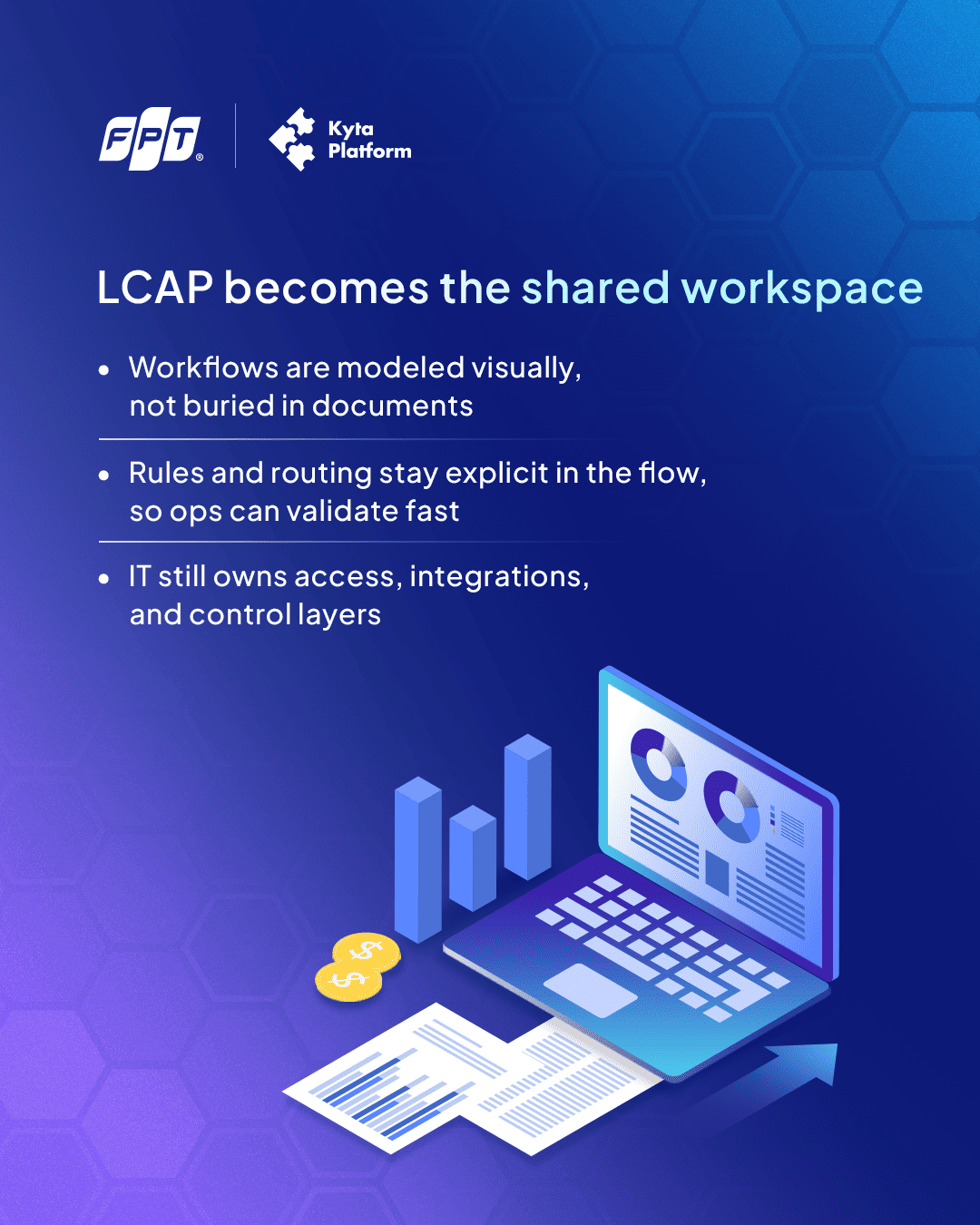
LCAP is not just a faster development tool. It is a shared visual environment where both sides finally see the same thing.
Workflows are drawn, not described.
Logic is modeled, not written in long specifications.
Rules are defined visually, not buried deep in custom code.
A business analyst can point at a decision node and say, “This approval should go to Finance if the amount is above fifty thousand.”
The workflow owner can adjust the logic in real time.
The IT architect still controls permissions, integrations, and security.
LCAP becomes a neutral ground.
A demilitarized zone where conversations shift from misunderstanding to co-creation.
From Requesting to Co-Creating
The most successful enterprises in 2025 no longer see IT as a service desk.
They build Fusion Teams: multidisciplinary squads where operations experts and technical experts collaborate directly on a single platform.
This model fundamentally changes how systems evolve.
Instead of waiting months for new features, business teams can validate ideas within days.
Instead of long requirement documents, teams iterate directly inside the platform.
Instead of silos, data flows across departments because processes are built together, not stitched together.
When people understand each other, systems become coherent.
When systems become coherent, organizations move faster.
When organizations move faster, transformation becomes real.
Conclusion
Breaking silos is not just about integrating systems. It is about aligning people around a shared way of building the future.
LCAP provides that shared language.
It turns IT and Business from two opposing camps into a unified operating engine.
It removes the friction between “what we need” and “what we can build.”
It creates operational clarity, collaboration, and speed.
In a world where agility defines competitiveness, the enterprises that win are the ones that move as one.


